How to Promote a Language Rich Environment at Home

A language rich environment is the act of nurturing a learning space designed to provide a stimulating setting to develop children’s language skills effectively. This is important to incorporate in the home, especially in early years, as it allows children to improve on interaction, focusing, talking and taking turns.
Words can be very powerful, so promoting a language rich environment in your home can have many positives for you and your child.
Research indicates that the quantity of words spoken to a child in their first three years of life is strongly associated with their language skills, vocabulary size and IQ later in life. This is also the case for children who are exposed to more positive feedback.
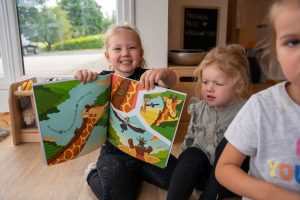
Here are our top tips on how to promote a language rich environment in your home.
- Slow down, get to your child’s level and be present in your interaction with them as much as possible.
Put your phone down, turn the TV off and close your computer. By being present and your child having your full attention, they are much more likely to communicate with you. - Talk to your child throughout everyday activities, tell them what you are doing and why you are doing it.
This is something so simple, but can have such a big impact on your child. Essentially, parents ‘thinking out loud’ allows your child to pick up on new words and associate them with certain actions. - Follow your child’s lead in everyday activities.
By actively observing and responding to your child’s verbal and non-verbal communication, it gives your child the opportunity to explore and expand their own abilities. - Don’t just focus on your child’s words, watch their pre-verbal and non-verbal communication.
Listen for non-verbal communication cues. This is especially important for children who are not yet communicating with any/many words. - Interpret your child’s messages.
This is for both verbal and non-verbal messages. It’s a good idea to interpret your child’s message back to them, based on your observations of your child’s actions, sounds and speech. In other words: You are going to make an educated guess on what you think he is trying to communicate. This will help you and your child with their communication and language development. - Respond meaningfully to your child and expand on what they say.
Give your child full attention, with close proximities when responding to what they say. You can respond in a number of ways such as, answering a question, expanding on what your child said, making a comment or imitating. For example your child says “my ball” becomes “my big red ball.” - Keep your language positive.
Although, sometimes you will have to say ‘no’, ‘dont’’ or ‘stop’ to your child, it’s important to balance these phrases with positive ones. - Reduce the amount of questions you ask.
Asking children questions puts unnecessary pressure on them to talk and it is easy to start asking more questions when they don’t answer, which makes them even more uncomfortable. - Provide your child with opportunities to communicate throughout the day.
For example, playing games such as ready, steady go and all fall down. You can do this when building towers or discussing the weather when walking! Make sure you have time every day to have a conversation with your child. - Read books to and with your child.
Reading is a fantastic way to promote a language rich environment. Not just the obvious, but you can ask questions, talk about the pictures, stress new words and have fun.
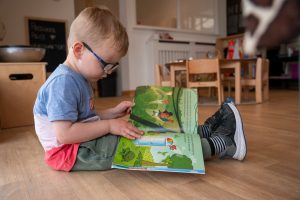
Here are some words and tips from Becky Whyle, Nursery Manager at Cherubs Wynndale
“We always get asked if a child’s home language is important to maintain at home, or if as a parent you should start talking English to your child. We recommend you talk to your child in your first language at home and let your child learn English from English speakers. That way, they have the best role model for each language.”
“We like to show and label objects as single words to encourage language skills. It is crucial for children to listen to talking before they can use it- Repeat,repeat, repeat.”
“Everywhere we go there are lots of noises for us to listen to! Children need quiet time to help them listen to talking rather than the other noises going on around them. We provide quiet times here at Cherubs Nurseries and you should as well.”
“Adults need to show children how to listen. When we listen to children, they learn what to do to be good listeners.”
“Keep Dummies for sleep times only! When a baby or young child has a dummy in their mouth they are less likely to copy sounds adults make or to attempt to babble and play with sounds themselves. This is important in the development of speech skills.”
“Songs and rhymes-are good to use at nursery age as they help children to learn patterns of speech and language, important skills when learning to read.”
Useful Sites:
www.thecommunicationtrust.org.uk
www.literacytrust.org.uk/talktoyourbaby