Children are born with an incredible capacity for learning. In the Early Years stage of development, it’s important that parents provide a rich, stimulating environment from home that encourages learning and development.
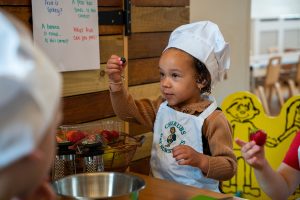
A nursery environment is there to encourage this, an observation of a child at play allows educators to understand the child’s motivation and development. Young children’s learning is often driven by their interests and therefore, at home, in the moment planning can be flexible and is based on a child’s interest. A rich environment means giving children lots of opportunities to play with maths concepts in their day-to-day lives—for example, by getting them involved in cooking or playing board games.

Play is an activity that is used by children to make sense of the world; you will observe them playing and practising favourite games and activities over and over again in order to explore, investigate and recreate.
Maths is one of the seven areas of the early years foundation stage and is used to develop a child’s confidence and ability with numbers, but also to encourage their understanding of shapes, space and measures. It is important children are able to do this in a range of ways including adding and subtracting, using quantities and objects and understanding concepts like weight, position, distance and money.
A good way to introduce maths into your child’s life is by using everyday objects around the house. For example, if there are five spoons in a row on the table, ask them what happens when you take away one spoon? You could also ask them what happens when there are ten cups of water but then one cup goes missing? This way they’ll start noticing patterns in their surroundings which will help them understand how numbers relate to real life situations.
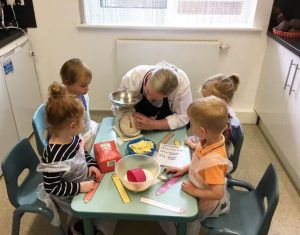
At snack and lunch times, the concepts of shape, size, quantity and length can be discussed. Whether cutting sandwiches, pouring juice or counting the number of people at the table. It is important to flood the environment regularly with mathematical language, as it provides multiple opportunities to express understanding through a range of activities:
- Play with building blocks
- Point out patterns
- Count numbers out loud
- Play with puzzles
- Draw and talk about shapes
- Create maths problems in everyday conversation
- Use a measuring tape
- Play board games
- A creative area
- Shape hunt

Make it meaningful by incorporating fun music and rhymes into their maths routine with lyrics to help learn and progress with language and speech, rhymes with patterns to familiarise them with counting and problem solving such as:
- One, two, buckle my shoe
- Ten little monkeys jumping on the bed
- One, Two, Three, Four, Five Once I Caught a Fish Alive…
- Ten in a bed
Nursery rhymes use patterns in language and speech, and by recognising patterns in language, children are also able to recognise patterns in numbers, which helps with mathematical problem solving.
There are plenty of resources online to gather some ideas for your at home teaching and learning, you can also ask your Cherubs Nursery Educators who are full of great ideas! Our nurseries often use playdough in activities as it is great to explore the benefits of the following in addition to supporting numeracy:
- Developing fine motor skills
- Calming for children
- Encourages creativity
- Enhances hand-eye coordination
- Improves social skills
- Supports literacy
- Promotes playtime
Moving the Maths learning outside gives children a bit of a break indoors, outdoor maths can be motivating, promoting a natural curiosity among children. Learning outside the classroom supports the development of healthy and active lifestyles by offering children opportunities for physical activity, freedom and movement, and promoting a sense of well being.
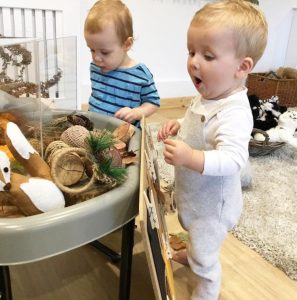
Our Forest School Lead Jess has shared some activities that would be great to implement:
0-2 year olds
- Counting natural resources outside, using plenty of number language
- Going on a ‘Shape hunt’ outside, introducing basic shapes
- Exploring a ‘Number Hunt’ – finding different numbers around an outside area and introducing numbers from 1-5
- Finding different objects from outside and using them to build with or stack with
- Using counting songs whilst outside e.g. 5 little ducks/speckled frogs
2-3 year olds
- Comparing sizes of sticks outside
- Going on a scavenger hunt for ‘Big’ and ‘small’ objects outside
- Collecting different objects from around outside areas and counting them, focussing on the numbers 0-5
- Building shapes with natural objects, focussing on basic shapes like squares, circles and triangles
3-5 year olds
- Gathering natural objects and counting them, focussing on the numbers from 1-10
- Symmetry with objects outside
- Using natural objects from outside to create different patterns
- Using objects from outside to create numerals to help with number recognition
- Using rulers to measure objects found outside
Encourage your children to play mathematically whilst noting their progression continually, which skills do they have and not have as well as the concepts they understand and misunderstand. As a result, children will be more likely to enjoy learning and develop into confident learners who are better able to achieve their potential throughout their school career.