The Benefits of Learning Through Play in Early Years
Co-Author: Lucy Tutin
Learning through play is a fundamental aspect of early childhood education that promotes holistic development in children. Play-based learning is an academic approach that recognises the natural curiosity, imagination, and creativity of young children. This blog explores the numerous benefits of learning through play, highlighting how play-based activities support various aspects of a child’s development.
1. Cognitive Development:
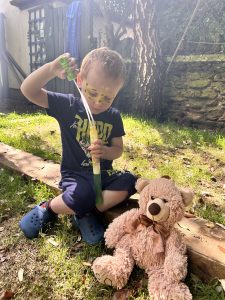
Play-based learning stimulates cognitive development by engaging children in problem-solving, critical thinking, and decision-making. Through play, children develop their cognitive skills such as memory, attention span, and information processing. Activities like building blocks, puzzles, and pretend play encourage children to explore cause-and-effect relationships, spatial awareness, and logical reasoning.
2. Social and Emotional Development:
Play provides a platform for children to interact and engage with their peers, leading to the development of social and emotional skills. During play, children learn to share, take turns, cooperate, negotiate, and resolve conflicts. They also develop empathy, communication skills, and emotional regulation as they engage in pretend play, role-playing, and imaginative scenarios.
3. Language and Communication Skills:
Play-based activities offer rich opportunities for language development and communication skills. Children engage in conversations, express their thoughts and ideas, and practice listening and responding to others. Through play, they expand their vocabulary, enhance their language comprehension, and develop narrative and storytelling abilities.
4. Physical Development:
Play-based learning actively promotes physical development in children. Active play, such as running, climbing, jumping, and balancing, helps children develop gross motor skills, coordination, and body awareness. Fine motor skills are honed through activities like drawing, painting, using playdough, and manipulating small objects, which support hand-eye coordination and dexterity.
5. Creativity and Imagination:
Play is an avenue for children to explore their creativity and imagination freely. Engaging in pretend play, dressing up, building with blocks, and engaging in artistic activities allow children to express themselves, think innovatively, and develop problem-solving abilities. This nurtures their imaginative thinking, originality, and fosters a sense of curiosity and exploration.
6. Executive Functioning and Self Regulation:
Play-based learning provides opportunities for children to practice self-regulation and develop executive functioning skills. Whether it’s following rules in a game, waiting for their turn, or planning and organising their play scenarios, children learn to regulate their impulses, focus their attention, and develop self-control. These skills lay the foundation for later academic success.
Our Approach
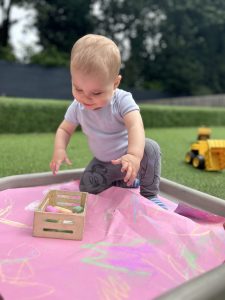
At Cherubs Nurseries, we have developed our own blended approach to early years, building on long-trusted teaching methods, the latest research, our own experience as an established nursery and childcare provider and the voices of our people and the families of the children we care for.
When developing our approach and curriculum, we have taken advice from experts and built a hugely experienced education team in-house who have led the development and successful implementation of our learning approach and curriculum.
Our blended approach brings together four main schools of thought: Montessori, Hygge, Reggio and Forest School. These influence all areas of our childcare services, including the environment, the structure of the nursery day and how our educators provide purposeful learning and development for the children. Our expertly trained and knowledgeable educators carefully follow the interests of each child, encouraging them to lead their own play, inspired by the world around them.
Forest Schools
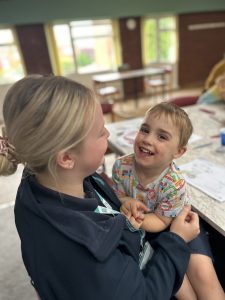
Part of our approach to early years is inspired by Forest School – we call it Explorers. Forest School is a child-centred inspirational learning process that offers opportunities for holistic growth through regular sessions. It supports play, exploration and supported risk taking. It develops confidence and self-esteem through learner inspired, hands-on experiences in a natural setting.
At Cherubs Nurseries, we have our very own qualified Forest School Teacher who supports and coaches all nurseries to provide weekly sessions. Taking place in a woodland or natural environment, it is a long-term program that supports play, exploration and risk-taking and supports the development of a life-long relationship between the learner and the natural world.
Learning through play in the early years offers an array of benefits that positively impact a child’s cognitive, social, emotional, language, physical, and creative development. By embracing play as a central component of early childhood education, we can foster well-rounded development and lay a strong foundation for lifelong learning.
See the links to our social media channels below where we regularly share content on all things childcare and learning through play in the early years.