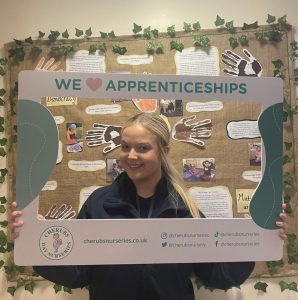
The Early Years are a vital part of a child’s education when they develop the cognitive, social and emotional skills that set them up for life. Early Years Professionals are crucial in helping children develop before starting primary school.
It’s easy to see why a career in Early Years education appeals to many, and the great thing is you need no previous experience to undertake an Early Years apprenticeship and begin this incredibly rewarding career journey.
As this week is National Apprentice Week, we have caught up with some of our Apprentices at Cherubs Nurseries (past and present!) and asked them what they wish they knew before starting an Early Years apprenticeship.
“You get to express your inner childlike side!”
One of the most exciting things about working in the Early Years is all the fun you get to have with the children, although the job entails a lot more than just ‘playing with children all day’. Playing games, having fun, running around the playground and doing arts and crafts with your little friends make all the hard times and piles of paperwork worth it! There will be many times when you feel like you are reliving your youth, whether that’s through singing nursery rhymes or doing silly dances.
“How exciting it is seeing your key children progress and reach their milestones!”
Early Years Educators work tirelessly in aiding children to flourish and develop. Every child is different, and each of them develops at their own pace. Whether it be their physical development, emotional development or communication and language development, each achievement makes us want to burst with pride and excitement. It truly is one of the most rewarding jobs you can have, and these moments are ever so beautiful to experience.
“How painful (but also exciting!) it is seeing the children move to big school!”
When you have spent the last three years watching these children develop and grow into lovely and caring little people, it will hurt when they leave and move to school. You go from seeing them every day to possibly never seeing them again. However, it’s so great to see how excited they are to take the next step and start primary school. All that progress they have made during their time at nursery has led them to this moment, and they will make heaps more progress during their school years.
“How much support and encouragement I would receive from my Nursery Manager, colleagues and Assessor!”
Working towards a new qualification can be challenging, and sometimes, it’s easy to feel overwhelmed and like the work is piling on top of you. The good thing about an Early Years apprenticeship is that there’s a huge support network all around you. Here at Cherubs Nurseries, all training and learning is done in-house through the Cherubs Nurseries Academy, so you will always be able to call your Assessor when you require support. Not only do you have your Assessor for support, but also your Nursery Manager and Assistant Nursery Manager, who will always be at your setting to help and answer any questions you may have. Also, you have your colleagues around you who will have worked towards the same or similar qualifications as you!

“How many nappies I would have to change!”
Children’s nappies need to be changed multiple times a day. At a minimum, children should be changed once in the morning, after every sleep and once in the afternoon. If a child’s nappy feels heavy, it should be changed immediately, and you should not wait until the designated change time. With this in mind, you are changing a child’s nappy at least three times while they’re at the nursery, and then when you consider how many children are in a nursery, that’s a lot of nappies!
“The amount of germs you will pick up in the first few months!”
Children are exposed to many bacteria and viruses as their immune systems are not as developed as adults as they haven’t been exposed to that many different germs yet. That means that, unfortunately, nurseries do hold a lot of different germs and illnesses, so it may feel like you are getting sick every two weeks. Ensure you keep up with handwashing and watch out for signs of sickness.
“How many skills I would learn and develop!”
Not only do you learn a bunch of skills that are related to being an Early Years Educator, skills such as observing and tracking children’s progress, feeding and changing babies and safeguarding, but you also learn many other skills that you can use in everyday life. Being an Apprentice allows you to develop your communication skills, teamwork skills, interpersonal skills and organisational skills.”
“It’s okay not to know what you are doing sometimes and ask questions!”
Going into a completely new profession can be daunting, and it’s completely normal to be unsure about things. The beauty of working in a setting like a nursery is you are surrounded by colleagues who started out just the same as you. Use these people for support and ask them questions; they will be able to help and guide you. Every day is different, so there will always be moments when you are unsure what to do, but all you can do is ask, and somebody will support you.
“It’s important to be a team player!”
Teamwork is a bonding agent which brings people together and allows you to motivate each other. Although the journey of being an Apprentice can be rather personal to you, it is still important to help and support those around you. Together, you and your colleagues can reach targets quicker and more efficiently by working as a team. It’s vital when working in an industry like Early Years education
“I can just be myself, always!”
It is always important to be your true and authentic self in all aspects of life for a number of reasons. Being yourself at work can lead to multiple benefits, such as better life satisfaction, healthier well-being and higher motivation levels, performance and activity. But most importantly, you are much more happy when you are being yourself and this will shine through in your work.
If you are interested in a Early Years apprenticeship, you can find out more or email our recruitment team at careers@cherubsnurseries.com for current opportunities.